
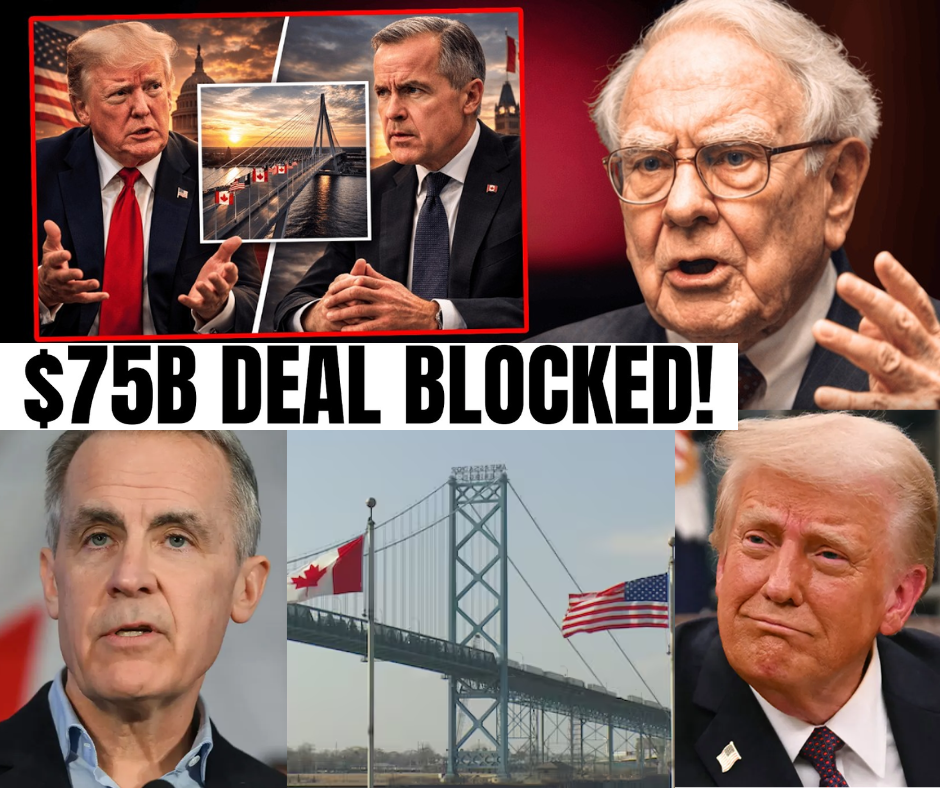
Did Canada Just Walk Away From the Largest U.S.–Canada Infrastructure Deal in History?
A dramatic narrative is circulating online: Canada’s Prime Minister Mark Carney has allegedly killed a $75 billion “North American Gateway Initiative,” the largest bilateral infrastructure agreement ever proposed between the United States and Canada. According to the story, the deal would have rebuilt and modernized the entire U.S.–Canada border—new bridges, expanded tunnels, high-speed freight rail, smart ports of entry, energy grid interconnections, and a fully integrated digital customs system. Fifteen years of construction. Four hundred thousand American jobs. A generational transformation of North American trade.
It’s a powerful storyline. It’s also one that demands scrutiny.
As of this writing, there is no public record of a finalized $75 billion U.S.–Canada “Gateway Initiative” being signed and then abruptly terminated. No official joint communiqués. No congressional appropriations. No parliamentary ratifications. No confirmed statements from Warren Buffett describing such a collapse in the language attributed to him.
That does not mean the underlying issues are fictional. Far from it. The broader questions raised by this narrative—about trade wars, infrastructure decay, and strategic realignment—are very real. And they matter deeply to American audiences.
The Infrastructure Reality at the Border
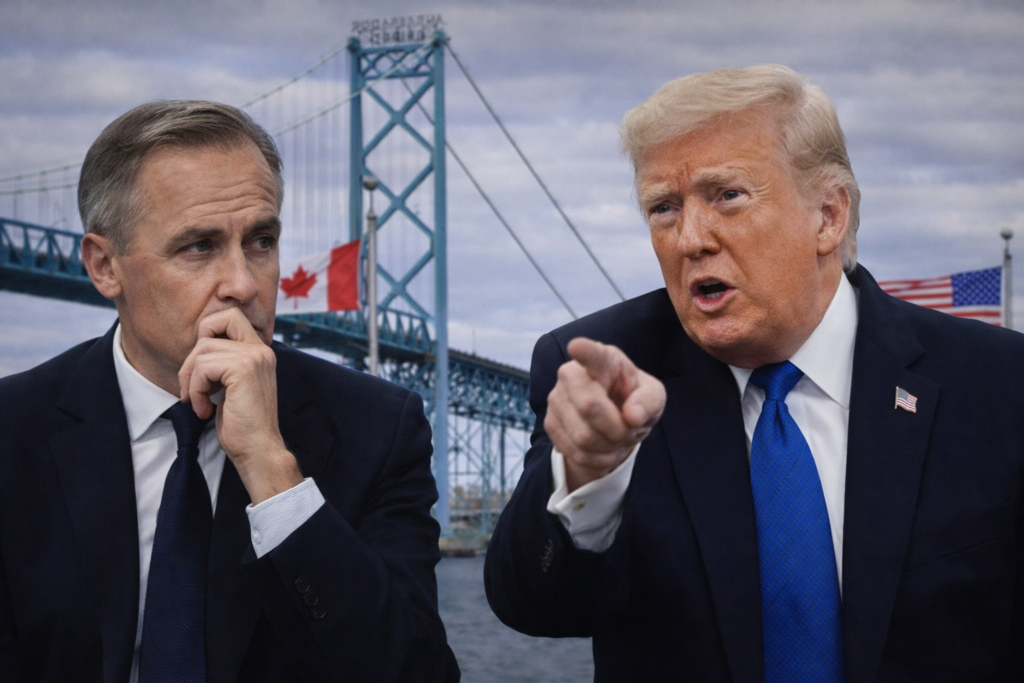
The U.S.–Canada border is the largest bilateral trade corridor in the world. Roughly $2 billion in goods crosses it every day. Much of that trade flows over infrastructure built in the early to mid-20th century.
The Ambassador Bridge between Detroit and Windsor opened in 1929. The Blue Water Bridge dates to 1938, though expanded. The Peace Bridge opened in 1927. Many customs facilities were built decades ago and retrofitted for the digital era rather than designed for it.
There have been modernization efforts—the Gordie Howe International Bridge, for example, is under construction—but the broader system remains uneven. Freight congestion, inspection delays, and aging capacity all impose real economic costs.
The United States faces a documented infrastructure gap. The American Society of Civil Engineers consistently grades U.S. infrastructure in the C range. Meanwhile, China has invested heavily in ports and rail through its Belt and Road Initiative. The European Union has modernized transcontinental transport networks. Southeast Asia is building high-capacity corridors at a rapid pace.
The competitive stakes are not imaginary.
Trade Policy and Strategic Trust
The script’s core claim is that tariffs and trade volatility destroyed the trust required for long-term infrastructure investment.
That argument is plausible in principle.
Large-scale infrastructure projects depend on predictable trade flows. If bilateral trade contracts because of tariffs, retaliatory measures, or supply chain uncertainty, the revenue assumptions behind toll roads, freight corridors, and customs modernization become unstable.
Canadian pension funds—among the largest infrastructure investors in the world—are known for prioritizing stability and long-term returns. If trade policy appears volatile, fiduciary logic would push capital elsewhere.
The United States, during periods of tariff escalation with allies, did generate friction not only with China but also with Canada, Mexico, and the European Union. Even when disputes are later resolved, the memory of unpredictability lingers in investment calculations.
Infrastructure is not built on political rhetoric. It is built on 20-year spreadsheets.
The Strategic Pivot Question
Another key theme in the narrative is that Canada is redirecting investment toward Pacific and Atlantic gateways—strengthening ties to Asia and Europe.
That trend has precedent. Canada has invested heavily in expanding the Port of Vancouver and Prince Rupert to handle Asia-bound trade. Halifax has been modernized as a transatlantic hub. Arctic shipping routes are being studied as climate change reshapes maritime geography.
Canada’s economy remains deeply integrated with the United States. But Ottawa has long pursued diversification to reduce overdependence on a single partner. That is strategic hedging, not hostility.
From a geopolitical perspective, middle powers diversify when major powers appear unpredictable.

The Buffett Factor
The script attributes sweeping, emotional remarks to Warren Buffett about generational loss and infrastructure ceilings.
Buffett has indeed criticized tariffs in the past, warning that “trade wars are bad.” He has also emphasized the importance of infrastructure and long-term investment. However, no verified public record shows him describing the collapse of a specific $75 billion U.S.–Canada infrastructure pact in the dramatic terms quoted.
That distinction matters.
But the broader idea he often expresses—that infrastructure determines economic ceilings—is historically accurate. The Interstate Highway System reshaped American commerce. The St. Lawrence Seaway transformed Great Lakes trade. Infrastructure projects can shift economic geography for decades.
What Would the Loss Mean—If Real?
If a deal of that scale were truly on the table and then withdrawn, the implications would be profound:
- Lost construction employment across border states.
- Continued reliance on aging bridges and tunnels.
- Slower freight throughput compared to European and Asian corridors.
- Reduced North American competitiveness in integrated supply chains.
- Strategic signaling that bilateral trust has weakened.
Even the perception of such a lost opportunity can affect investor psychology.
The Political Dimension
Border-state governors historically advocate for infrastructure and trade stability. Michigan, New York, Washington, and others depend heavily on cross-border commerce. Any significant contraction in U.S.–Canada cooperation would generate bipartisan pressure for resolution.
Trade policy is rarely abstract in these states. It is measured in auto plants, agricultural exports, and logistics jobs.
The Bigger Debate for America
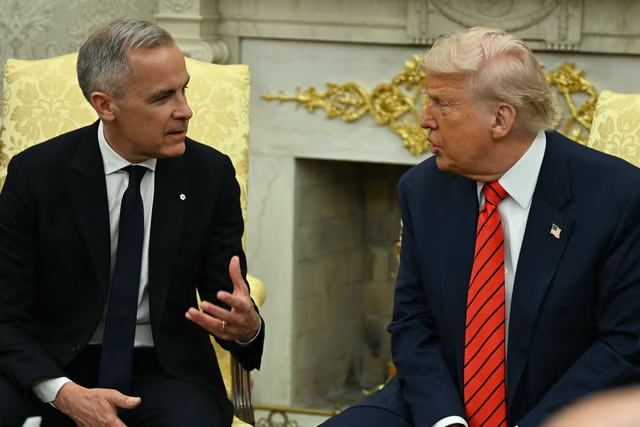
Whether or not the specific $75 billion initiative existed in the form described, the core debate is real and urgent:
Is the United States building the infrastructure needed to lead in the 2030s?
Are tariffs strengthening national resilience—or undermining long-term integration with allies?
Can North America function as a unified economic bloc in an era of intensifying global competition?
America’s closest ally is not China or Russia. It is Canada. The durability of that partnership is a strategic asset.
If that trust erodes—not through war, but through policy misalignment—the consequences will not be visible in a single news cycle. They will show up slowly: in port rankings, in freight efficiency metrics, in comparative investment flows.
Infrastructure is quiet power.
The real question for American voters and policymakers is not whether one deal was killed. It is whether the United States can still align trade strategy, infrastructure investment, and alliance management into a coherent long-term vision.
Because if North America fails to modernize together while Europe and Asia surge ahead, the cost will not be measured in headlines.
It will be measured in lost decades.