Mara’s stomach tightened. “What does that mean?”
“It means you do not touch anything in that room. You do not let the boy touch anything. You clean the west shelves, empty the ash bowl, polish the globe, and leave.”
“I understand.”
Rosa stepped back. “God forgive me. Go.”
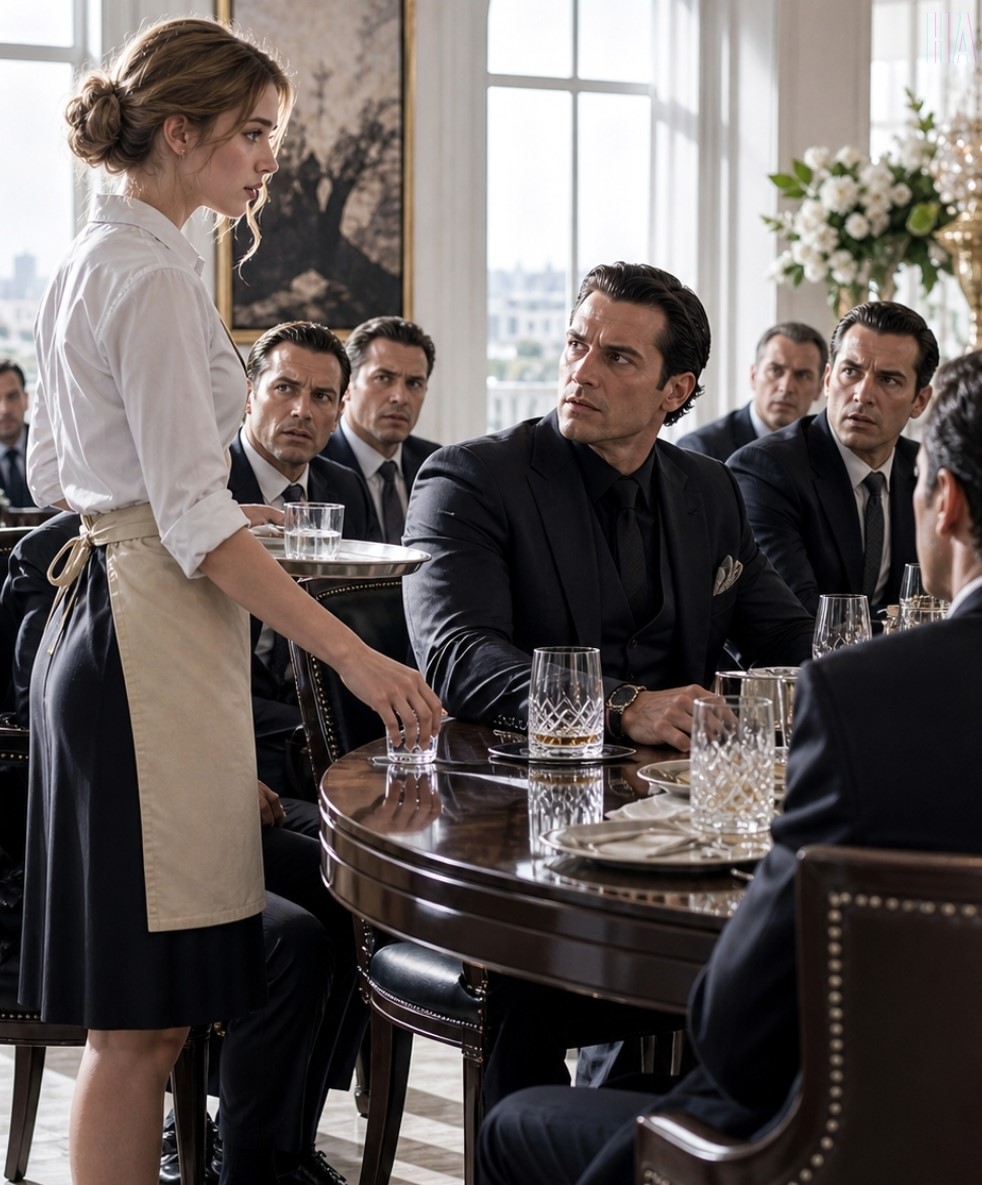
Mara led Caleb down a corridor lined with oil portraits and dark wood. The whole house smelled of cedar, coffee, wax, and money. Not new money. Old money. Money that had learned how to lower its voice.
Halfway to the study, Mara saw a man near the tall window at the end of the hall.
Leon Sarto.
She knew his name because Rosa had warned her on the first day.
Mr. Romano’s right hand. Do not smile at him. Do not joke with him. Do not be alone with him if you can help it.
Leon stood with his back partly turned, phone pressed to his ear. He wore a navy suit and a gold ring on his smallest finger. His voice was low, but Mara caught the words anyway.
“He’s in the study. New maid’s with him. Yeah, she brought the kid.”
A pause.
Then Leon said, “Relax, Mr. Costello. Romano doesn’t know anything yet.”
Mara’s steps faltered.
Leon turned his head slightly.
Mara lowered her eyes and kept walking, squeezing Caleb’s hand hard enough that he looked up at her.
“Mom?”
“Keep walking, baby.”
She did not know who Mr. Costello was. She only knew that men like Leon did not say names like that in hallways unless something terrible was attached to them.
At the study door, Mara stopped, swallowed her fear, and knelt in front of her son.
“Caleb, listen to me.”
“I’m listening.”
“The man in that chair is Mr. Romano. He is very important. He is also not someone we upset.”
Caleb looked past her.
Dominic Romano sat near the fire, head tilted, one hand resting on the armrest. His dark hair was touched with silver at the temples, though he was only thirty-eight. A thin scar ran from his left eyebrow toward his hairline. Even sitting still, he looked dangerous.
“He’s sleeping,” Caleb whispered.
“Maybe. Maybe not. It doesn’t matter. You sit right there by the corner of the rug. You do not touch the books. You do not touch the desk. You do not touch the watch. You do not touch the money.”
Caleb’s eyes flicked to the desk, then back to her.
“I won’t.”
Mara hated the next words before she said them.
“If we lose this job, I don’t know how we pay for your medicine.”
Caleb’s face changed.
Not fear exactly. He had known too much fear already. It was a small, quiet acceptance, the kind children should never have to learn.
“I’ll be careful, Mom.”
She kissed his forehead, tasting rainwater there, then stood and went to work.
She cleaned fast. Too fast. Her mind kept circling back to Leon’s voice.
Mr. Costello.
Romano doesn’t know anything yet.
She dusted a shelf, wiped the globe, straightened a stack of leather-bound books, and carried a tray of empty espresso cups toward the door. She meant to return immediately. She meant to keep Caleb in sight.
But in the hall, Rosa caught her.
“The silver delivery is wrong,” the older woman whispered urgently. “Come check before the driver leaves.”
“It’ll take one minute,” Mara said.
It took seven.
Seven minutes was enough time for a child who knew what pain sounded like to decide a sleeping stranger was hurting.
Caleb did not think of stealing the money. He saw it, of course. Any child would. It looked fake to him, like money in a movie, wrapped too neatly to be real. The watch shone under the lamp like something from a museum.
But his mother had said not to touch anything.
So he looked elsewhere.
He looked at the fire. At the painting above it. At the framed photograph on the bookshelf of a woman laughing in a yellow dress, her dark curls blown across her cheek. Caleb stared at that photo longer than anything else.
She looked kind.
Then the man in the chair breathed wrong again.
Caleb knew wrong breathing.
He had heard it in hospital rooms and at home in the last month of his father’s life. His father, Ben Bennett, had been a math teacher with gentle hands and a terrible diagnosis. Pancreatic cancer had taken him in less than a year. Before that, Caleb had had heart surgery for a ventricular septal defect. He remembered lights over an operating table. He remembered waking up with tubes. He remembered his father’s hand in his.
Once, in the pediatric ICU, an old man behind the curtain had cursed every nurse who touched him. Caleb had been scared.
His father had leaned close and whispered, “People who hurt badly sometimes sound mean. Don’t decide who they are until you ask where it hurts.”
Caleb had never forgotten that.
So now he rose from the rug.
He did not go to the money.
He did not go to the watch.
He crossed to Dominic’s chair and laid his hand gently on the man’s scarred knuckles.
“Mister,” he whispered, “does your chest hurt?”
Dominic did not answer.
Caleb waited. When the man stayed still, Caleb looked around the room for something useful. A folded wool blanket lay across the sofa. It was heavy, but he dragged it with both hands and spread it over Dominic’s legs. He tucked the corner beside the chair the way his mother tucked blankets around him when his chest ached on cold nights.
“My dad got cold too,” he whispered.
Dominic felt the blanket settle over him.
He kept his eyes shut.
The boy moved away.
Now, Dominic thought.
Now comes the reach.
The footsteps went toward the desk. Dominic let one eye open the width of a thread.
Caleb stood beside the mahogany desk, looking at the money that hung over the edge. He reached out, and Dominic’s fingers tightened near the pistol.
The boy pushed the cash back so it would not fall.
Then he looked at the watch.
Dominic waited.
Caleb did not touch it.
Instead, the boy dug into the pocket of his sweatshirt and took out an orange prescription bottle. He placed it carefully on the desk beside the watch.
“Mister,” he said, “if your chest hurts, you can take one. Just one. They help me when my heart feels funny. You can borrow them.”
Dominic opened his eyes.
The bottle sat beside eighty thousand dollars of gold and steel.
Digoxin.
Pediatric dose.
Caleb Bennett.
Dominic stared at it until the letters blurred.
Then the door opened.
Mara stepped inside and saw the room in one terrible sweep.
The blanket over Dominic’s legs.
Her son out of his assigned corner.
The orange pill bottle on the desk beside a watch she knew was worth more than every debt her dead husband had left behind.
“Caleb,” she breathed.
The boy turned. “Mom, he—”
“What did you do?”
Her voice cracked so sharply Caleb flinched.
Mara crossed the room and snatched the pill bottle from the desk. Her hand shook so badly she almost knocked over the lamp. She turned toward Dominic, who had closed his eyes again, because some cruel part of him still wanted to see what she would do.
Would she blame the boy?
Would she slap his hand?
Would she become what fear made people become?
Mara dropped to her knees beside the chair.
“Mr. Romano,” she whispered. “Please. He didn’t mean any harm. He’s seven. He doesn’t understand what things cost. I’ll pay for anything he touched. Take it out of my wages. All of them. Please don’t fire me. Please don’t call anyone.”
Dominic opened his eyes.
Mara froze.
He looked not at her face, but at the bottle clutched in her hand.
“Give it back to him,” he said.
She stared.
“He’s cold,” Dominic said quietly. “And he needs his medicine.”
Mara did not move for several seconds. Then she crossed back to Caleb, knelt, and gave him the bottle. Her fingers lingered against his cheek, checking him, counting him, making sure he was still hers.
Dominic sat forward.
The blanket shifted.
His face hardened because tenderness embarrassed him more than anger ever had.
“Miss Bennett,” he said, pointing toward the watch, “do you know what that is?”
Mara shook her head.
“Eighty thousand dollars. And I saw a small fingerprint on the crystal.”
There was no fingerprint.
He had seen none.
But the lie worked. Mara went white.
“Please,” she said. “Please don’t. I can work it off. I don’t have anyone. If I get arrested, he has no one. His medicine—his appointments—please, he can’t go into the system.”
Dominic watched carefully.
This was where people revealed themselves.
Mara turned and pulled Caleb behind her, putting her own body between him and Dominic.
“Not your fault,” she whispered to the boy. “Listen to me. This is not your fault. I shouldn’t have brought you here. I made the mistake, not you.”
Dominic’s throat tightened.
Caleb stepped around his mother.
He reached under his collar and pulled out the leather cord. At the end of it hung a small cloudy stone, pale as moonlight through fog.
“My dad said this is a moonstone,” Caleb said. “He wore it when he was sick. Mom says it’s special.”
He lifted it over his head and placed it on the desk beside the watch.
Then he looked at Dominic with steady, frightened eyes.
“Will you take it for the watch? So my mom doesn’t owe you?”
Dominic could not speak.
His late wife, Lydia, had owned a moonstone like that. She had worn it under her wedding dress because her grandmother had given it to her. It was locked upstairs in a jewelry box he had not opened since the funeral.
For three years, Dominic had believed grief had turned him to stone.
But stones cracked.
He stood slowly, walked to the desk, picked up the leather cord, and knelt in front of Caleb.
The boy did not step back.
Dominic placed the moonstone over Caleb’s head and settled it against the faded sweatshirt.
“You keep this,” he said. “There is nothing in this house worth what that is. Not the watch. Not the money. Not the house.”
Caleb closed his hand around the stone.
“Yes, sir.”
Dominic stood and looked at Mara.
“I was not asleep.”
Her face changed.
“The cash and the watch were a test. I have done it with every person Rosa has hired for almost two years.”
Mara said nothing.
“Seven people failed.”
“Did you need them to fail?” she asked.
The question was so quiet he almost missed the blade inside it.
Dominic looked toward Lydia’s photograph on the shelf.
“Yes,” he said. “I think I did.”
Then, for reasons he would not understand until much later, he told her the truth.
He told her about Lydia, four months pregnant, driving herself to a doctor’s appointment because Dominic had been in a meeting he should never have attended. He told her about the black SUV that had run the red light in Brooklyn. He told her about the stolen plates, the vanished driver, the garage owned by Victor Costello, and the proof Dominic had never been able to put in a courtroom.
He told her about his cousin who stole two million dollars and disappeared.
He told her about his lawyer wearing a wire.
“I decided everybody had a price,” Dominic said. “It made life simple. Ugly, but simple.”
Mara’s expression softened, but not enough to become pity.
“My son doesn’t,” she said.
“No,” Dominic said. “He doesn’t.”
He went to the desk, opened a drawer, and took out a checkbook.
“How much did your husband’s treatment leave?”
Mara stiffened. “That’s not your concern.”
“It is if you work in my house.”
“I clean your house. You don’t own my life.”
For the first time that day, Dominic almost smiled.
“No,” he said. “I don’t.”
He wrote the check anyway.
Three hundred and twenty-eight thousand dollars.
Paid in full for Benjamin Bennett.
Mara stared at the number as if it were a threat.
“I can’t take this.”
“It isn’t charity.”
“It is exactly charity.”
“No,” Dominic said. “Charity is what rich people call money they give away so they can admire themselves afterward. This is repayment.”
“For what?”
He looked at Caleb.
“For reminding me I am not dead.”
That was how Mara Bennett stopped being a housekeeper.
Not immediately. Not cleanly. Nothing in Dominic Romano’s life changed cleanly. But over the next three months, the Romano estate shifted around her and Caleb as if the house itself were waking from a long illness.
Rosa trained Mara as house manager.
Caleb was given a room on the second floor with blue walls and glow-in-the-dark stars on the ceiling. Dominic bought him a telescope and spent two hours reading the instruction manual aloud because Caleb struggled with the technical words but refused to admit it.
On Fridays, they ate in the kitchen instead of the dining room. Rosa made pasta. Caleb explained planets, dinosaurs, and why cats were “basically tiny lions with better manners.” Dominic laughed one night so suddenly that everyone at the island went silent.
He looked startled by the sound.
Caleb grinned. “You laugh weird, Nick.”
Dominic blinked. “Nick?”
“Dominic is too big.”
Mara looked horrified. “Caleb Bennett.”
But Dominic only picked up his fork.
“Nick is fine.”
The first time Caleb drew a picture of the three of them, he included an orange cat none of them owned. Dominic pinned it to the refrigerator beside a business card from the FBI’s Manhattan field office. Mara saw the card, saw the name printed on it, and said nothing.
Dominic noticed.
“You are not going to ask?” he said.
“No.”
“Why?”
“Because if you wanted me to know, you’d tell me.”
He looked at her for a long moment.
Then he said, “I may need to become a different man.”
Mara answered carefully. “Then become one.”
That night, Dominic stood in the hall outside Caleb’s room and watched the boy sleep. The moonstone lay on the nightstand beside his water glass. The telescope pointed toward the cloudy sky. Caleb’s breathing was even.
Dominic pressed a hand to his own chest.
For years, he had protected his life because it belonged to him.
Now there were two people in the house whose lives had somehow become tied to his.
That made him afraid.
And because Dominic was not a foolish man, fear made him observant.
The first warning came from a wine shipment seized at the port.
Only three people had known about the container.
Dominic.
Tony Greco, his old friend and underboss.
Leon Sarto.
The second warning came when one of Dominic’s bookkeepers was murdered outside a steakhouse in Secaucus after a meeting Leon had arranged.
The third came when a safe apartment in Brooklyn was broken into and cleaned out with professional care.
Three incidents.
Three weeks.
Leon’s shadow on all of them.
Dominic wanted evidence before he moved. He owed Leon that much. Five years earlier, Leon had stepped in front of a bullet meant for Dominic on a loading dock in Sunset Park. The bullet still sat near Leon’s right shoulder blade. Dominic had paid for his mother’s apartment in Palermo, his daughter’s school, his wife’s house in Queens.
He had called Leon brother.
Then one morning, Mara came into the study with coffee and a face too pale for ordinary worry.
“I need to tell you something,” she said.
Dominic closed the ledger in front of him.
“The first day I brought Caleb here,” she said, “I heard Leon on the phone in the hall. He said you were in the study. He said the new maid had brought a kid. And then he said, ‘Mr. Costello, Romano doesn’t know anything yet.’”
The room went silent.
Dominic did not ask why she had waited. Her face told him.
Three months ago, she had been a terrified widow with a sick child and no power. Now she trusted him enough to risk the truth.
“Pack a small bag tonight,” Dominic said. “You and Caleb. Medicine in your purse, not the suitcase. Tony will drive you to a house in Connecticut at ten.”
Mara’s eyes sharpened. “You think Leon knows?”
“No.”
But Dominic was wrong.
Leon knew because five weeks earlier, he had placed a microphone behind the study’s crown molding.
He heard every word.
At 11:12 that night, while rain returned to Long Island, four men came over the rear wall of the Romano estate at the blind spot Leon had created in the camera system. The service door was already unlocked.
Rosa saw them first.
She was carrying chamomile tea up to Caleb because the boy had been nervous about the “weekend trip.” She opened her mouth to scream. One of the men struck her with the butt of a gun. The cup shattered on the tile.
Upstairs, Mara heard the sound and stepped into the hallway.
A cloth went over her mouth before she could call Caleb’s name.
In Caleb’s room, the boy saw his mother fall.
He ran for the bay window.
He did not make it.
A man caught him around the ribs. Another pressed a sweet-smelling cloth over his face. Caleb held his breath as long as he could, the way nurses had once taught him before a procedure, but the darkness came anyway.
Before it swallowed him, he saw Leon standing in the doorway.
“Uncle Leon?” Caleb whispered. “Where are you taking us?”
Leon’s face twitched.
For one second, he looked like a man remembering he used to be human.
Then he said, “Somewhere your friend Nick will follow.”
Caleb woke in a warehouse near the water in Red Hook.
His mother was tied to a chair ten feet away. A yellow bulb swung from the ceiling. Rain ticked against high windows. The air smelled of rust, oil, and the river.
“Mom?” he whispered.
Mara lifted her head. Relief and terror crossed her face at the same time.
“Baby, stay still.”
A side door opened.
Victor Costello entered wearing a camel-colored coat and polished shoes. He was sixty, silver-haired, handsome in the way expensive knives are handsome. Leon followed behind him.
Costello studied Mara first.
“So this is the woman who taught Dominic Romano to feel again.”
Mara said nothing.
Costello smiled.
“I have been trying to hurt that man for years. I killed his wife, you know. Not personally. Men like us outgrow personal work. But I ordered it. And still he did not break properly.”
Mara’s blood went cold.
Costello turned to Caleb.
“But then you came along.”
Caleb sat on a crate, holding his moonstone.
Costello crouched in front of him.
“Are you afraid of me, little man?”
Caleb looked directly into his eyes.
“You’re a bad man,” he said. “But you’re hurting too.”
Costello’s smile vanished.
“What did you say?”
“My dad said people hurt other people when something inside them hurts and nobody helped it.”
Leon looked away.
Costello stood.
“Your father was sentimental.”
“My father was good.”
The old man’s hand moved so fast Mara barely saw it. He slapped Caleb across the face.
Mara screamed his name.
Leon flinched.
Caleb did not cry. He pressed one hand to his cheek and looked at Costello with wet eyes.
“That didn’t make you less hurt,” he whispered.
Costello stared at him.
Then he turned to Leon.
“When Romano comes, put the gun to the boy first. I want to see what kind of man he has become.”
Dominic came at 3:17 in the morning.
Not alone.
And not by the old rules.
He had already made a call to the FBI agent whose card was pinned to his refrigerator. He had spent weeks feeding her evidence on Costello’s smuggling routes, shell companies, murder orders, and federal bribes. He had planned to use the law as a blade.
But when Caleb and Mara were taken, the blade became immediate.
Dominic, Tony, and ten trusted men reached the warehouse before the federal tactical team because fear drives faster than procedure.
They entered through three sides.
The fight lasted four minutes.
When Dominic kicked open the inner office door, he saw everything at once.
Mara tied to the chair.
Caleb beside her.
Costello in the far corner.
Leon behind the boy with a pistol pressed to Caleb’s temple.
“Stop right there, Nick,” Leon said.
Dominic stopped.
Tony froze behind him.
Mara’s eyes locked on Dominic’s.
Caleb stood very still.
“Leon,” Dominic said.
“Don’t.” Leon’s voice cracked. “Don’t say it like that.”
“Like what?”
“Like you’re disappointed.”
“I am.”
Leon laughed bitterly. “You treated me like an employee and called it brotherhood.”
“I trusted you with my life.”
“You trusted me to die for you.”
Dominic’s eyes moved to Leon’s right shoulder.
“No,” he said softly. “I remembered that you almost did.”
For a moment, something opened in Leon’s face.
Then Costello snapped, “Shoot the boy if he moves.”
Caleb’s right hand slipped slowly into his pajama pocket.
Dominic saw it.
So did Mara.
Neither moved.
Caleb pulled out his orange medicine bottle. He let it fall from his hand.
It hit the concrete with a bright hollow sound and rolled toward Leon’s shoe.
Reflex is older than betrayal.
Leon looked down.
Dominic raised the Desert Eagle and fired once.
The bullet struck Leon high in the right shoulder, the same shoulder where he had once taken a bullet for Dominic. The pistol fell from Leon’s hand. Tony kicked it away before it stopped sliding.
Caleb ran into his mother’s lap as Tony cut her free.
Costello lifted his hands.
The sirens arrived seconds later, long and layered, federal and city together. Blue windbreakers flooded the warehouse. Victor Costello was taken alive. Leon was carried out on a stretcher, conscious, pale, and whispering one sentence over and over.
“I’m sorry, boss.”
Dominic stood over him before they took him away.
“I owed you one bullet,” Dominic said quietly. “Now we are even.”
Leon’s eyes filled.
Dominic turned away before forgiveness could become another lie.
At dawn, back at the estate, Rosa was alive with a concussion and stitches. Caleb was asleep on Dominic’s chest in the same leather chair where the test had begun months before. The wool blanket covered them both. Mara sat across from them with a mug of tea she had forgotten to drink.
Outside, the rain had finally stopped.
“Nick,” Mara said softly, “we can’t live like this.”
Dominic looked at her.
“No,” he said. “We can’t.”
She swallowed. “Then Caleb and I should go.”
Dominic rested one hand on the boy’s back, feeling the steady rise and fall of his breathing.
“I met with the U.S. Attorney four weeks ago,” he said. “I started before tonight. I’m cooperating fully. Costello goes down. The illegal side of my father’s business ends with me.”
Mara stared at him.
“The house will be sold. The name will disappear. Tony will keep the legal companies clean or he will lose them. There’s a town in northern Michigan where a man named Daniel Reed is opening a small construction office in the spring.”
“Daniel Reed?”
“Dull name. Clean papers.”
Despite everything, Mara almost smiled.
Dominic looked down at Caleb.
“I am not asking you to marry me,” he said. “I am not asking you to forgive the life I lived. I am asking you to stay long enough to see if the man I am trying to become is someone you and Caleb can trust.”
Mara crossed the rug and knelt beside the chair.
Caleb stirred, opened one sleepy eye, and saw them both.
“Are we going home?” he murmured.
Mara looked at Dominic.
Then she touched the moonstone at Caleb’s throat.
“Yes,” she whispered. “I think we are.”
Six months later, in a small town near Lake Michigan, a boy with a repaired heart stood on a porch at dusk and aimed his telescope toward a clear spring sky. His mother sat nearby, wrapped in a blanket, reading a book she kept forgetting to turn the pages of.
Inside the modest white house, a man who had once been Dominic Romano washed three coffee mugs by hand because the dishwasher was too loud and because he had learned there was peace in ordinary work.
Caleb ran inside.
“Nick! Jupiter’s out!”
The man dried his hands.
“I’m coming.”
Caleb paused in the doorway, studying him with the serious expression that had changed all their lives.
“Does your chest hurt today?”
Dominic looked at Mara.
Mara looked back.
Something gentle passed between them.
“No, buddy,” Dominic said.
Caleb smiled. “Good.”
Then he ran back outside, moonstone bouncing against his sweatshirt, calling for them to hurry before the planet moved.
Dominic followed.
Behind him, Mara turned off the kitchen light.
For the first time in years, no one in the house was pretending to sleep.
THE END